

Recently, someone made the false assertion that we at TTR oppose all extrabiblical research and especially "man-made dictionaries" in Bible Study. This claim is nothing more than a straw man fallacy taken from our statement that extrabiblical sources are fallible and should not be relied upon as the final authority for defining terms or understanding doctrinal teaching. However, when one has no valid answer to an argument, the usage of misrepresentations in the form of straw men arguments are often employed. Prideful men, who crave the admiration of their followers and seek validation from their peers use this tactic in their presentations. It is a manipulation technique which wreaks of hypocrisy and lies.
For thousands of years, various religions have sought validation for their teachings and dogmas from so called "church fathers." -Men who are esteemed to be the authority in the understanding and practical application of God's Word. Every religion can trace their beliefs back to a mere man's words about what their god says. The instructions that their gods would have the world to know needed interpretation, and for that interpretation, a human apologist was needed. This human apologist is always the final authority on what the god(s) wanted the world to know and understand.
This practice of revering religious "fathers" is no different in religious Christianity. The "church fathers" have been referenced for hundreds of years in all attempts for the "christian believer" to understand and know what God has said. All christian sects (denominations) have their own favorite "church father" whom they esteem above God's own written Word. These men are the very reason why denominations exist within what is called the Christian faith.
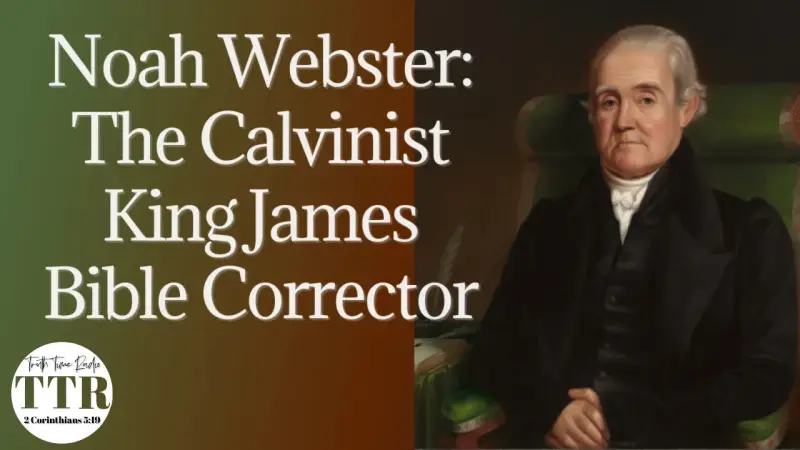
Book after book can be (and has been) written as proof of denominationalism's reliance upon the words of men for their respective belief systems, but this blog entry will just be focusing on one single man: the man to whom many, who will call themselves King James Bible believers, will turn in order to define terms within God's Word - Noah Webster, Jr.
Webster grew up in Hartford, Connecticut. Often esteemed as an American Patriot for enlisting for service during the Revolutionary War, there is no doubt that he had a passion and love of the country for which he served. However, he had his own ideas of how things should be done. As a former school teacher turned lexicographer, his main political goal was uniting a nation of immigrants via his own implementation of National Spelling Reform.
According to Webster, regional dialects, along with the usage of languages such as French and German, further divided an already fragmented country. He feared that the influence of dialects in particular would “corrupt the national language.” After a speaking tour in the American South, Webster was said to be horrified by the dialect of his countrymen, citing their pronunciation of common words as "repugnant" and criticizing their schoolrooms as disgraceful or nonexistent. Webster also had a great distaste for Elizabethan English, and often complained that the King James Bible was written in the dialect spoken during the time in which it was translated.*
When Webster’s famous speller was first published, politicians were actually debating the elimination of English for Americans. Some wanted to adopt German for America while others wanted to invent a new language altogether. Webster offered a compromise, envisioning a new, sanctified version of English to go with the new, independent identity. An avowed nationalist and born-again Christian, Webster was not an unbiased lexicographer. He envisioned the U.S. as successor to the Roman and Greek empires and hoped its burgeoning legacy would soon inspire a tradition of literature to surpass that of England. Webster’s dream of American exceptionalism underscores how the act of making a dictionary is by its very nature political, dictating the ways in which people communicate. Webster’s particular political agenda was an authoritarian one, and it veered into a total intolerance of difference.*
In the century following the Revolutionary War, Webster’s American Spelling Book became so ubiquitous in the newly formed United States—selling an estimated hundred million copies—that its sales were outpaced only by those of the Bible. *
“To diffuse an uniformity and purity of language in America, to destroy the provincial prejudices that originate in the trifling differences of dialect,” wrote Webster in the preface of the speller, “is the most ardent wish of the author.”
By capturing language not as it was written in England but as it was spoken in the U.S., Webster intended to lay the foundation for a uniform American speech that could supersede European linguistic traditions. Where other instructional texts might capture existing modes of speech, he sought to elevate a new way of speaking, and in some sections one might say the speller read more like a political treatise than a children’s schoolbook.*
By the time Webster began writing his dictionary in the early 1800s, public interest in his vast linguistic project had dwindled, and so he found fresh energy from a new source: God.
While working in his study in 1808, Webster claimed he spoke with God, "falling to his knees and confessing his sins." From that day forward he was a devout Calvinist and a "born-again Christian." His understanding of the dictionary shifted to incorporate his newfound religion. He became convinced that Chaldean was the pure language of God, and the very first language spoken in Genesis. He also believed that the confounded languages from the Tower of Babel all derived from Chaldean. Furthermore, he came to believe that the language of the Saxons was most closely related to what he assumed to be the purest language of God. With this conviction (ie. premise), he embarked on a series of wildly unscientific etymological investigations, trying to find common roots for words in languages originating in Asia, Africa, and Europe.*
The final project of his research, published in 1828, is a work of gigantic proportion, containing some seventy thousand words, including nouns that did not exist in England, such as skunk and squash. Webster erased some of his more radical spellings, such as wimmen for women and tung for tongue, but the removal of u in words such as honor and color remained. His attempts to remove any and all words which were not commonly spoken in America, and to cause those words in the scriptures which he deemed "vulgar" or "obscene" to cease usage in his new "Purely American" language was well underway.*
Webster’s 1828 dictionary should not be noted only for its new spellings and scope, but also for its ethos, which reflects its author’s convictions, his vision of the country as a fundamentally "new place" that would serve as an example for the rest of the world. While other English dictionaries used William Shakespeare for usage examples, Webster referenced George Washington, Benjamin Franklin, and Washington Irving, elevating them in the ranks of literature as they never had been before. The preface echoes his devotion to a patriotic cause, calling the task of writing an American dictionary not just important but “necessary” for “preserv[ing] an identity of ideas.” He even required the inclusion of U.S.-specific definitions for words such as Senate (“the higher branch or house of legislature”) and plantation (a farm “where the labor is performed by slaves”), as part of this "American" identity.*
Although Webster was raised in a devout Congregationalist Calvinist home, it wasn't until 1808, during the second wave of the American "Great Awakening" that he made his profession of faith - in the manner which the Calvinist religion refers to as "conversion experience." Without this evidence of conversion, Calvinistic theology does not accept one's profession of salvation.
It would behoove anyone who is unfamiliar with the "Great Awakening" movement (which is actually a response to the "enlightenment" movement from Europe) to research the doctrines which were taught during that time, as well as the opposing thoughts to this movement. It is all purely Calvinistic reformation teaching in content, with its supposed purpose of a freedom from the concept of national religion being hypocritical, at best. In short, the whole debacle from start to finish was nothing more than an attempt to remove its followers from the bondage of the "national religion" only to replace them under the bondage of a different "national religion."
Yes, Noah Webster was a self-professed "born-again Calvinist." This fact is evidenced in his writings, in particular an easily accessed online letter to his brother-in-law (Judge Thomas Dawes of Boston) where he describes his conversion experience. The very salvation of the man who wrote this highly revered 1828 dictionary of the American language is in question, no doubt. An excerpt describes Webster's conversion experience as this:
"My mind was suddenly arrested, without any previous circumstance of the time to draw it to this subject and, as it were, fastened to the awakening and upon my own conduct. I closed my books, yielded to the influence which could not be resisted or mistaken, and was led by a spontaneous impulse to repentance, prayer, and entire submission and surrender of myself to my Maker and Redeemer."
He further iterates:
"That these impressions were not the effect of any of my own passions nor of enthusiasm is to me evident for I was in complete possession of all my rational powers, and that the influence was supernatural is evident from this circumstance; it was not only independent of all volition but opposed to it. You will readily suppose that after such evidence of the direct operation of the divine spirit upon the human heart, I could no longer question or have a doubt respecting the Calvinistic and Christian doctrines of regeneration, of free grace, and of the sovereignty of God."
This "conversion description" puts the U and I in TULIP.
Anyone notice what is missing in this "conversion?" Within the entirety of the letter which the above excerpts were taken from, the gospel is nowhere to be found: no cross, no death, burial, or resurrection - nothing of believing anything concerning the ONLY gospel of our salvation for today. The name of Jesus is nowhere in this entire profession of faith, with the word "Christ" only mentioned once in reference to Webster's former disbelief in the deity of the Son of God. No payment for sin, nothing about forgiveness, no mention of eternal life or Heaven. No, Webster's "salvation experience" was based on his own "repentance." And if you look up "repent" in his dictionary, you'll see what he means when he uses the term:
"In theology, to sorrow or be pained for sin, as a violation of God's holy law, a dishonor to his character and government, and the foulest ingratitude to a Being of infinite benevolence."
-According to Webster, his salvation consisted of a bit of Calvinistic rhetoric, with a nod to the "free grace" that is included in the U part of the TULIP. Yet ultimately, his entire conversion experience was implicitly self-focused, and not Christ-centered.
While some will assume that just because Noah Webster cited verses from the King James Bible within his definitions, it somehow validates the belief of his dictionary being the superior mode of usage in defining the terms within the scriptures, most will ignore his ulterior motives. If the very title of the dictionary including the words "American Language" is not enough of a clue that this is not the appropriate book to rely on for deciphering the words in the ENGLISH (from England, not America) translation of the scriptures - I don't know what is.
Webster made no attempts to hide his theological beliefs from anyone. Nor did he veil the fact that he hated the usage of terminology and phrases that were not often employed within his locale of New England. Obviously, dialects and languages differed throughout America. With the exception of the Native peoples who were either exterminated or indentured into slavery, America was made up solely of immigrants from various parts of the world, who spoke different languages. And while a common language is necessary for communication, Webster made no secret of the fact that he abhorred the usage of certain languages and dialects within America which he was not accustomed to. In other words, Webster wanted to be the one who chose how Americans communicated and spoke, based on his own prejudices and biases, without regard for the interests of others. And to this end, he was mostly successful.
But Webster's interest in redefining and eliminating certain phrases and terms did not end with his 1828 dictionary. He felt he had more work to do, and his next venture would be his most imperialistic undertaking: His audacious revision of the King James Bible.
For a man who despised the linguistic nature of the very book he claimed to revere, this was the only next logical step for a self-titled lexicographer. (His 2 year Yale Education earned him a position of school teacher. He didn't study law there, as has been claimed by some publications.) Because Webster knew that the King James Bible was the most used book in educating American youth at the time, even more-so than his extremely popular "Blue Backed Speller" - he knew that his dream of authoring a single common language for America would never come to fruition, as long as the American people were still relying so heavily on the Book (KJB) that did not reflect his goals.
Webster’s translation of the KJB is based on two central assumptions. Firstly, like his dictionary, one of the most conspicuous things about Webster’s Bible is his insistence that purity of language fosters purity of character. Stemming from his assumption that proper English functions as both a marker and facilitator of civility, Webster regarded the Bible as a crucial means of conveying grammatical propriety. He argued in the preface to his Bible that because the Bible is a text read by everyone and used in schools to teach children how to read and write, it “has no inconsiderable influence in forming and preserving our national language." Functioning as a standard not only of religious doctrine but of proper English, he said the Bible “ought to be correct in grammatical construction, and in the use of appropriate words." **
Webster so very obviously did not believe that the King James Bible was appropriately translated. He also claimed that it was grammatically inferior to his "American language." So, the only thing left for Webster to do was to change the Book that stood in the way of his agenda.
Most people have probably never heard of the Webster Bible. That's because it never gained traction. Webster’s Bible proved to be a publishing disaster, a fact that can be explained partly by the fact that no clergyman would publicly endorse his translation. In fact, Webster’s Bible made so minor an impact on American society that it has become one of the rarest bibles ever produced. With the exception of its adoption by New Haven’s (CT) city schools, Webster’s Bible was so inconsequential that he was forced to authorize price reductions within the first three years: from $3 in 1833 to $1.50 by 1836. **
Apparently, during the 1800's, most were still offended by attempts to change the Word of God. So, if nothing else, Webster's efforts to correct God's Words did nothing more than to serve the purpose of showing that there was, at least, a time in this nation when God's Words were seen to be perfectly preserved in the King James Bible, and that the practice of changing them to suit one's taste or beliefs was frowned upon by the masses.
However, time changes certain things: history gets rewritten, and narratives are revised to suit the predilections of the one who is doing the narrating. When defending ideologies, and attempting to support those ideologies with historical evidence - most people tend to highlight the parts they like, and omit the parts they don't. Such is the case with the reverence amongst some King James Bible believers toward their beloved Noah Webster, and the authority that is given to his 1828 dictionary.
Webster was an extremely devout man, brought up in Calvinism via the Congregationalist Church. Since his conversion to the revivalist version of Calvinism in the spring of 1808, Webster apparently kept his KJB with him always, "correcting" spellings and grammar, making notes in the margins, and substituting American terms for what he considered as "obscure and obsolete concepts."
In the preface for Webster's Bible, he writes:
"a version of the scriptures for popular use, should consist of words expressing the sense which is most common, in popular usage, so that the first ideas suggested to the reader should be the true meaning of such words, according to the original languages. That many words in the present version, fail to do this, is certain. My principal aim is to remedy this evil."
Did you catch that? Webster believes that all bibles should be the same, but not in the way that most King James Bible advocates believe that "all bibles should be the same." -No. Noah Webster was an advocate for changing the words which he deemed as obsolete or archaic in scripture to reflect the linguistic style of the current modern era. This means that today, Noah Webster would be an advocate for new modern versions of the scriptures, because currently, we do not speak the same way they did in the 1800's. Today, Noah Webster would either pick his favorite modern bible version and promote it as the standard, or he would just create a new one, himself. But one thing is for certain, he would NOT advocate for that standard to be the King James Bible. Let's be clear on that.
In just this one quote from the preface of the Webster Bible, we can see that Noah Webster only revered the Word of God to the extent of his own interpretation of it. When he speaks of the "many words in the present version failing to represent the true meanings," the present version he is referring to IS the King James Bible. Furthermore, he refers to the fact that the words contained in the King James Bible did not reflect the current dialect spoken of his time as an "evil" which he intended to "remedy."
So, is there any question here of what Noah Webster actually thought of the preservation of God's Word in English being the King James Bible? Are we going to continue with this false narrative that Webster respected the KJB as THE words of God in English, and that he believed the same King James Bible we hold as truth today, was suitable for the American audience in childhood education, as well as national religious doctrine?
In this blog, we have only addressed one term (repent) among the scores of obvious incorrect definitions of bible words in Webster's 1828 dictionary, according to the context of the scriptures which the words are actually used. This is an easily researched fact, and would take a large amount of time and space to address. Instead, let's dig a little deeper into the final work of Noah Webster, his (thankfully unsuccessful) attempt to change the words in THE Book, to suit the words in his dictionary.
Those admirers of Mr Webster who do address his bible, tend to claim that there are so few changes, one would be hard pressed to find the differences from what is contained in the KJB. This is an outright lie made in order to protect an image. Those who were alive at the time of Websters bible publication knew better. And those who claim only mild alterations are banking that no one will research their claims. Don't fall for it.
It is quite telling that this quote is often used when praising Webster:
"The Bible is the chief moral cause of all that is good, and the best corrector of all that is evil in human society; the best book for regulating the temporal concerns of men, and the only book that can serve as an infallible guide to future felicity."
However, that is where the quote ends for most. Go to any pro-Webster 1828 website, or just about any KJO website and you will find the above quote. I have yet to see full quote, including the very next sentence from the same paragraph, included with these famous Noah Webster words on any of those sites. Even more ironic, Webster wasn't speaking of the KJB when he penned the often quoted sentence above. He was speaking of his own bible. All one has to do is read what follows as proof:
"With this estimate of its value, I have attempted to render the English version more useful, by correcting a few obvious errors, and removing some obscurities, with objectionable words and phrases; and my earnest prayer is that my labors may not be wholly unsuccessful."
These are Webster's own words, taken from the preface of his attempt at changing the Word of God. Why would anyone who is promoting the KJO position ever quote from a man who was so obviously not KJO, that he went so far as to correct the King James Bible with a new version of it? Remember what we said earlier about picking and choosing the parts of history that we like and omitting the ones that we do not? Can you find a more precise example of doing such a thing than by the very ones who have given Noah Webster the authority to tell them what the King James Bible "really means?"
Most any King James Bible advocate will tell you that as soon as you hear someone say "a better rendering of the word is..." or "should have been translated as..." when referring to the scriptures, it is a clear sign that they do not believe that the King James Bible is God's preserved Word in the English language. And yet, we have the man (Noah Webster) who made it his life's work not only to utter those phrases concerning the King James Bible, but to also take his biases so far as to call it "vulgar" "offensive" "indecent" "impure" "undignified" "erroneous in translation" and even "evil." Webster thought it his "moral duty" to correct these things, and as a result, produced his own version of the bible.
This is not exactly "hidden" information - all it takes is a cursory reading from the preface of his bible to ascertain how he really felt about the King James Bible.
Just how many "changes" to the KJB did Noah Webster make in his revision? Most Webster advocates will minimize it by saying he only changed archaic words like kine to cow or that he only lightly corrected perceived grammatical errors and updated spelling. Those who make these claims are, once again, banking on the fact that research will not be done and that their narrative will carry the day. Unfortunately, that is often the case. However, one needs to look no further than, once again, the preface contained within the very book in question. Noah Webster was apparently so proud of his work that he listed every change he made, along with his commentary about it. We counted 196 "general" changes in the list. However, this does not take into account that single general changes are used multiple times throughout the scriptures, because the original words which were changed were used multiple times. For example, consider the following admitted scriptural changes with the potential numbers (which we did not attempt to estimate) attached to them (from the preface):
"-Who is substituted for which, when it refers to persons.-Its is substituted for his, when it refers to plants and things without life.-To is used for unto. This latter word is not found in the Saxon books, and as it is never used in our present popular language, it is evidently a modern compound. The first syllable un adds nothing to the signification or force of to; but by increasing the number of unimportant syllables, rather impairs the strength of the whole clause or sentence in which it occurs. It has been rejected by almost every writer, for more than a century.-Why is substituted for wherefore, when inquiry is made; as, “why do the wicked live?” Job 21.7.-My and thy are generally substituted for mine and thine, when used as adjectives. The latter are wholly obsolete.-Wherein, therein, whereon, thereon, and other similar compounds, are not wholly obsolete, but are considered, except in technical language, inelegant. I have not wholly rejected these words, but have reduced the number of them; substituting in which, in that or this, in it, on which, etc."
With just that small amount of information, one must readily estimate that the number of changes is far higher than the 196 general changes that we counted from the list.
Furthermore, Webster didn't believe that the general American public would ever understand what simple terminology such as "kinsmen" "spoil" or "pollute" really mean, so in his zeal to preserve a pure "American" language, he got rid of those words (and MANY others) as well.
-And then there are these changes that cannot be overlooked. (From the preface:)
"-Passover for Easter. Acts 12.4. The original is pascha, passover.-Men, brethren. Acts 13.15, &c. The translators have erred by inserting and between these words, which tends to mislead the reader into the opinion that these are addressed as different characters; whereas the sense is men, brethren, men who are brethren.-How that. These words are frequently used very improperly, where manner is not expressed in the original. The original is simply that. This is another instance of an inconsiderate use of popular phrases. 1 Cor. 10.1; 15.3.-Holy Spirit. The word ghost is now used almost exclusively for an apparition, except in this phrase, Holy Ghost. I have therefore uniformly used Holy Spirit.-Demon. In the scriptures, the Greek daimon is rendered devil; but most improperly, as devil and demon were considered to be different beings. I have followed the commentators on the New Testament, in substituting demon in all cases where the Greek is daimon. I cannot think a translator justified in such a departure from the original, as to render the word by devil. The original word for devil is never plural, there being but one devil mentioned in the scriptures.-Hell. The word hell in the Old Testament, and sometimes in the New, is used, not for a place of torment, but for the grave, region of the dead, lower or invisible world; sheol in Hebrew, hades in Greek. I have in most passages retained the word in the text, but have inserted an explanatory note in the margin. In Ezekiel 31, I have rendered the word grave in two or three verses, to make the version conformable to verse 15.-Against for by. 1 Cor. 4.4. By in this verse must signify against, or the translation is erroneous. But by has not that signification in present usage; I have therefore substituted against.-There are many passages in which the translators have inserted and improperly, between clauses which are in apposition, and ought not to be made distinct. In 1 Cor. 4.13, the words and are appear to give a sense not intended by the apostle. “We are made as the filth of the world, the offscouring of all things.” So stands the original; but by the insertion of and are, the apostle is made to say not only that we are in estimation made as the filth of the world, but that we actually are the offscouring of all things."
The selections above are by no means exhaustive of the entire list, as well, it should be noted that several "euphemisms" were inserted in order to make the KJB renderings less "offensive" or "vulgar" according to Webster. In addition to this, he admits to making numerous changes to word tenses and literary style.
Also, it must be of note that Webster took it upon himself to remove the word "God" in several places, as he believed phrases such as "God forbid" were not intended to be there according to "the original text," and in his own words, "the insertion of them in the version, has given countenance to the practice of introducing them into discourses and public speeches, with a levity that is incompatible with a due veneration for the name of God."
In other words, he didn't like it when others invoked the name of God in speech or conversation. So he didn't want to encourage it by leaving an example in God's Word, and therefore REMOVED God's name from those particular passages.
Although lengthy, this is just a cursory look at the man, Noah Webster: his theology, his goals, and accomplishments. This isn't the part of Webster that is usually promoted by his admirers. But it is the unbiased truth of who the man was, what he believed, and what he did, nonetheless.
Did Noah Webster get some things right in his 1828 dictionary? Of course he did, and of those things that he got right, you might be able to gain some further insight into certain terms. But you also may get quite a few things wrong, should you rely on his understanding as your final authority concerning the scriptures. The saying goes, "Even a broken clock is right twice a day." But that broken clock will only give you the correct time for 2 out of 1,440 minutes. The take-away lesson: use scriptural discernment from the King James Bible in ALL of your studies.
Question: With this unpopular information in mind, understanding how his own ideologies influenced his life's work, knowing the biases he possessed, and getting some insight into his theological beliefs and his not-so-hidden agenda - how can a person who calls themself a King James Bible believer, in good conscience, continue to blindly support the works of Noah Webster, Jr. in regards to understanding God's Word?
(Sources: *Jess McHugh, 2018; **C. Dowdell, 2006)
Add comment
Comments